It is not incumbent upon the world to conform to your vision of change. – Jay Samit

credit: pixabay
credit: pixabay

Do you have an idea that is failing to launch? Seth Godin, the NetworkingBlogFather, calls ideas that explode Purple Cows. If your purple cow is failing to launch, there is a tendency to want to explain this away as ‘well they just don’t understand the idea or the potential’.

I have engaged in this line of thought, too, thinking that an idea I had was just waiting to go viral. If just the right person picked it up, or just the right person saw the potential, then surely it would explode across the Internets.

Then I read Disrupt You! by Jay Samit and came across this line:

It is not incumbent upon the world to conform to your vision of change. – Jay Samit

This rocked my metaphorical world. I’d been expecting the potential of my idea to speak to people, to speak for itself.

But, that’s not how this works. If a consumer has to realize the potential of the idea and look passed delivery of the same, the idea will probably not launch.

If your idea isn’t launching, take an objective look (or have someone else do so).

Does the idea answer a specific, easily articulated need?

If not, it is incumbent on YOU as the idea owner to figure out a new approach.

 

10thHuman: Best personal development book you’ve read?

credit: pixabay
credit: pixabay

I read. A lot.

In doing so, I hope to gain insight into the wisdom of those who came before us.

I hope to learn new ideas and perspective.

I also read toward the goal of synthesis. I hope that by reading a wide variety of books across multiple disciplines, I can see connections and add value where there are opportunities.

Along these lines, I’d ask, “What’s the best personal development book you’ve ever read?”

I highly recommend Seth Godin’s Linchpin and Napoleon Hill’s Think and Grow Rich.

Evolve or fail…

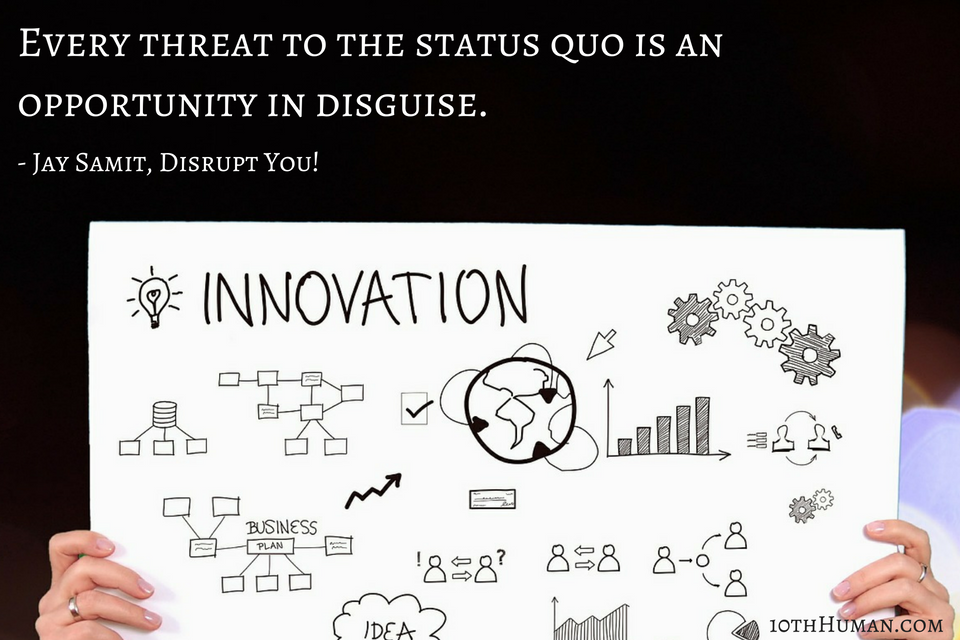
Every threat to the status quo is an opportunity in disguise.“Most CEOs see the future as a continuation of the path that got them to the C-suite and not as an ever evolving jungle.” 

– Jay Samit, Disrupt You! 

This is a lesson for anyone in a position they’ve worked to obtain. In our interconnected, global economy, disruption can occur from anywhere and at any time.

What got you there will not keep you there. 

The only way to stay on top is to continue to innovate.

Use an iterative framework, like the OODA loop, to continually evaluate what your are doing and why.

John Boyd: On uncertainty and preparedness

credit: pixabay
credit: pixabay

“If uncertainty is indeed pervasive, it is imperative for organizations to create the ability to operate comfortably in this condition…”
– Frans P.B. Osinga, on John Boyd 

The 21st century business environment is complex. It is perhaps the most complex business environment to exist in the history of commerce. We have built an infrastructure that supports inter-global commerce. A tribesman of the Masai Mara selling wood carvings can, with a connection to the Internet, connect to consumers in America. The scale and potential of this economy is staggering.

It’s also disruptive in that it defies continued domination of a marketplace by a single idea. Google disrupted Yahoo, Facebook disrupted MySpace. Startups are pulling niche traffic (like sales) from Facebook groups and Craigslist.

Uncertainty is a guiding principle of this globally connected marketplace.

Are you positioned to shift?

10thHuman: Why businesses need to constantly evaluate their strategies

image from pixabay
image from pixabay

Today, I want to talk about the 2nd law of thermodynamics.

This law states:

…the total entropy of an isolated system always increases over time, or remains constant in ideal cases where the system is in a steady state or undergoing a reversible process. The increase in entropy accounts for the irreversibility of natural processes, and the asymmetry between future and past.

Why does an organization need to be familiar with this concept?

The short answer is that a business that does not engage in the continual evaluation of their operations becomes isolated from their competition. Their entropy increases.

This requires continual energy input, to mantain that constant level of entropy. You have to do the work, the planning, the execution.

Then, do it again.

Then, do it again.

The strategy that got you to the top will not work to keep you there. 

You will be disrupted, unless you are disruptive.

How do you achieve this state, this disruptive nature, this continual evaluation? Through the use of a consistently applied framework.

10thHuman: Why you should engage in permission marketing

tree-200795_640
image from pixabay

3,000

That is the average number of ads the average consumer sees in a given day. That is 2.083 ads per minute, on average.

How many of those ads do you pay attention to?

How many do you click on?

How many of those ads did you consent to receive?

If you’re like me, the answers are “very few, even less and almost none.”

Permission marketing, according to the MarketingBlogFather Seth Godin, is:

the privilege (not the right) of delivering anticipated, personal and relevant messages to people who actually want to get them. It recognizes the new power of the best consumers to ignore marketing. It realizes that treating people with respect is the best way to earn their attention.

I would ask you to consider this question:

How do you stand out in a field saturated – utterly saturated – by marketing? 

By asking permission.

You may lose sales to aggressive ad campaigns but I suspect you will build long term loyalty.

10thHuman: Organizations and sustained adaptability

network-1433045_640I’m reading Team of Teams by General Stanley McChrystal today and would share this with you today, found in the opening pages:

(Organizations) must shift from efficiency to sustained organizational adapatability.

With the speed of disruptive technology today and the tools with with competition can emerge from “nowhere”, organizations cannot be content to maintain. What allowed them to achieve market dominance will not sustain the same.

What are your value adding links?

image from pixabay
image from pixabay

“A business or product can be understood as the sum of it’s value adding links.”

Jay Samit

For me, this quote inspires me to daily ask myself, what are your value adding links in my business/product/network? 

Why is this an important question to ask?

If you don’t know where you are adding value, you cannot focus your efforts on those parts of your business. 

It seems to me that a critical part of a successful enterprise is knowing where you adding value, especially in an age of scarce resources (money, attention, time).

The Internets: The wealth of human information at our fingertips…

network-1433045_640Have you paused recently to consider that we, the human species, have developed a network that is simultaneously:

  1.  the distributed repository of the wealth of human knowledge
  2.  connects everyone with access to everyone with access

The potential of this network extends far beyond sharing awesome memes (though this is arguably a critical function).

Today’s link is a list of 14 resources compiled by Mental Floss that run the gamut from serious (learn every language on Earth and helping feed the Earth) to the lighthearted (access old school video games).

All powered by the Internet.