10thHuman: What To Do When You Make a Mistake

Apologize. 

Make it right, if you can.

Try to forgive yourself.

We all make mistakes. We are but human. When we do, I think the three steps above are the starting point for addressing the mistake and trying to rebuild the damaged trust.

I know that when I make a mistake, for me #3 – forgive yourself – is the hardest. I often cannot move past a mistake mentally unless the person against whom I have transgressed offers forgiveness or at least acknowledgement that I offered an apology.

From a business perspective, I would offer that there is a step 4. Actually, as I type this I realize this is both a personal and business step (given the nature of this blog, I automatically started to step through a business process / checklist). That is: figure out how to prevent such an error as caused the mistake from happening again.

As a businessperson, maybe this evaluating the process you were going through and adding a step to a checklist.  As a human, this is engaging in introspection and perhaps asking yourself, “How did I wrong this person? Is this something I can change about myself or the way I conduct myself?”

I would offer that the very concept that spawned this blog – the 10th man concept – is itself a process aimed at preventing errors. Essentially, the job of the 10th man in an organization is to argue against the boss’ decisions, regardless of how they really feel about it. In this process, the thought is that it enables the boss make better decisions.

I don’t offer definitive answers here, only food for thought from one imperfect human.

10thHuman: Complex systems evolve and change

Complex systems evolve and change. People are complex systems.
– Rob Thompson

I am big on frameworks and systems. These help people build and scale their businesses and personal lives.

However, people are complex systems and our frameworks need to build in the flexibility and space to accommodate this and themselves evolve.

10thHuman: On the value of asking a question

image from pixabay
image from pixabay

I’m reading A More Beautiful Question right now by Warren Berger and came across this insight.

One good question can give rise to several layers of answer, can inspire decades-long searches for solutions, can generate whole new fields of inquiry, and can prompt changes in entrenched thinking. – Stuart Firestein

I suspect Firestein is coming at this from a deep philosphical perspective but this is applicable to our existing businesses, too. For example, from a business perspective, I continually ask myself, How can I add value?

What is your question?


Warp Speed, Mr. Sulu! Or, how I am trying to be more intentional in life and business

credit: pixabay
credit: pixabay

As a society, in almost every imaginable way, we are moving at Warp Speed.

In our personal lives, in our relationships, in our businesses, we are – to quote the great Seth Godin – ‘times 10‘ all the time.

When was the last time you hit pause and throttled back for a moment to evaluate what you are doing and how?

I think about this a lot. I’ve blogged about the needs of business to have a framework like OODA, where they are engaged in a systematic evaluation of there business space. I’ve also talked about the need to constantly evaluate strategy.

Remember, what got you there will not keep you there. (me)

The ability to learn faster is the only sustainable competitive advantage.(Senge)

How are you implementing this in your life/business?

10thHuman: Why you should continually evaluate your framework

Every threat to the status quo is an opportunity in disguise.I’ve previously blogged about the need of businesses to evaluate their strategies as a function of thermodynamics:

The short answer is that a business that does not engage in the continual evaluation of their operations becomes isolated from their competition. Their entropy increases.

I’ve also discussed this as a function of the evolution of a business in a competitive marketplace.

What got you there will not keep you there. 

Today, I’d expand that line of thought by citing Anthony Giddens, a sociologist, and a particular thought on structures:

Structures do not determine outcomes, but define the potential range of outcomes. (Giddens)

In the context of the running discussion here about strategies and frameworks, I think it reasonable to posit that a framework and strategy do not determine an outcome but helps define the potential range of outcomes. Specifically, it helps you consider input, evaluate your options and execute your decision in accordance with defined parameters (such as goals and values).

10thHuman: Best personal development book you’ve read?

credit: pixabay
credit: pixabay

I read. A lot.

In doing so, I hope to gain insight into the wisdom of those who came before us.

I hope to learn new ideas and perspective.

I also read toward the goal of synthesis. I hope that by reading a wide variety of books across multiple disciplines, I can see connections and add value where there are opportunities.

Along these lines, I’d ask, “What’s the best personal development book you’ve ever read?”

I highly recommend Seth Godin’s Linchpin and Napoleon Hill’s Think and Grow Rich.

Evolve or fail…

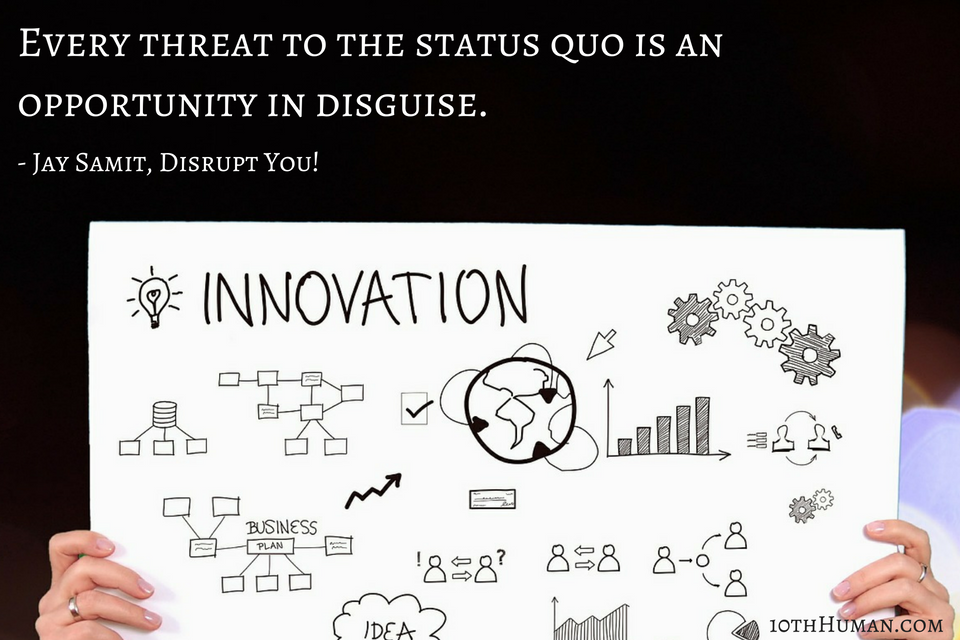
Every threat to the status quo is an opportunity in disguise.“Most CEOs see the future as a continuation of the path that got them to the C-suite and not as an ever evolving jungle.” 
– Jay Samit, Disrupt You! 

This is a lesson for anyone in a position they’ve worked to obtain. In our interconnected, global economy, disruption can occur from anywhere and at any time.

What got you there will not keep you there. 

The only way to stay on top is to continue to innovate.

Use an iterative framework, like the OODA loop, to continually evaluate what your are doing and why.

John Boyd: On uncertainty and preparedness

credit: pixabay
credit: pixabay

“If uncertainty is indeed pervasive, it is imperative for organizations to create the ability to operate comfortably in this condition…”
– Frans P.B. Osinga, on John Boyd 

The 21st century business environment is complex. It is perhaps the most complex business environment to exist in the history of commerce. We have built an infrastructure that supports inter-global commerce. A tribesman of the Masai Mara selling wood carvings can, with a connection to the Internet, connect to consumers in America. The scale and potential of this economy is staggering.

It’s also disruptive in that it defies continued domination of a marketplace by a single idea. Google disrupted Yahoo, Facebook disrupted MySpace. Startups are pulling niche traffic (like sales) from Facebook groups and Craigslist.

Uncertainty is a guiding principle of this globally connected marketplace.

Are you positioned to shift?