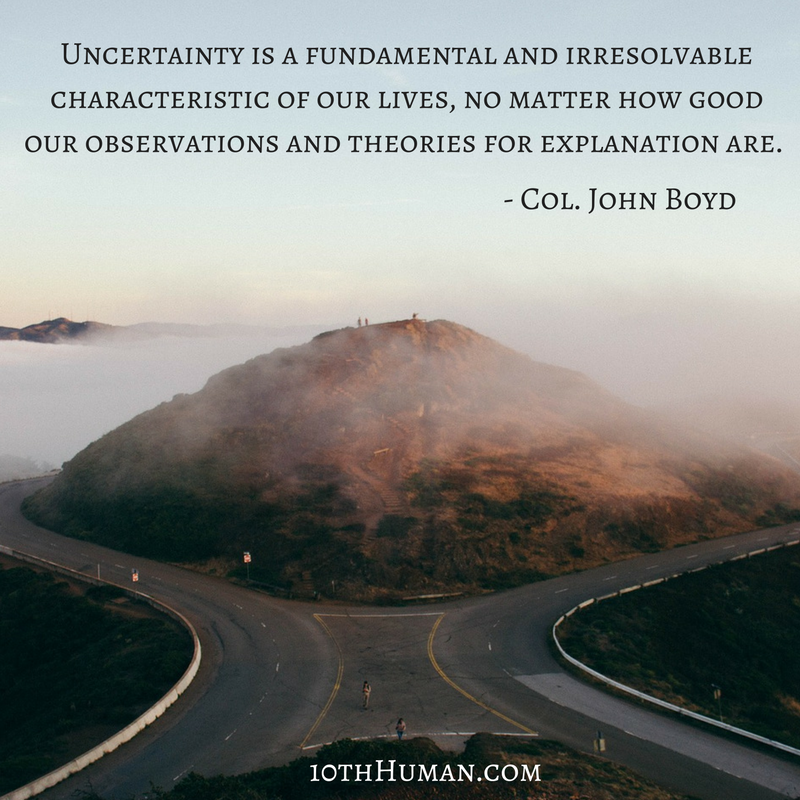
The future of content marketing…

credit: pixabay
credit: pixabay

5,000

That is the number of decisions the average consumer is faced with every day (reference The Organized Mind: Thinking Straight in the Age of Information Overload).

I’ve blogged about permission marketing and the power of authenticity but I wanted to talk today specifically about what the future of content marketing looks like.

Rachel Strella has a great post up here that talks about three major takeaways. It’s worth the read, for sure.

There’s something I’d highlight today that I think a lot about: quality, authoritative content.

With the massive amount of posts, tweets, blogs, snapchats, instagrams, etc., out there, if you are producing surface level content you are shouting into the void.

I think to make a difference, to be heard, you have to establish yourself as a passionate advocate and student of your niche. Some would say be the ‘expert’, but there’s a finality to that word that I don’t subscribe to personally.

Every day, study your art.

Every day, practice your art.

Every day, share your art.

Become the voice of your art with quality, authoritative content.

10thHuman: Why businesses need to constantly evaluate their strategies

image from pixabay
image from pixabay

Today, I want to talk about the 2nd law of thermodynamics.

This law states:

…the total entropy of an isolated system always increases over time, or remains constant in ideal cases where the system is in a steady state or undergoing a reversible process. The increase in entropy accounts for the irreversibility of natural processes, and the asymmetry between future and past.

Why does an organization need to be familiar with this concept?

The short answer is that a business that does not engage in the continual evaluation of their operations becomes isolated from their competition. Their entropy increases.

This requires continual energy input, to mantain that constant level of entropy. You have to do the work, the planning, the execution.

Then, do it again.

Then, do it again.

The strategy that got you to the top will not work to keep you there. 

You will be disrupted, unless you are disruptive.

How do you achieve this state, this disruptive nature, this continual evaluation? Through the use of a consistently applied framework.

10thHuman: is momentum in business real?

Momentum is defined as the impetus gained by a moving object. It is a principle, a vector quantity of the product of mass and velocity. It is a quality often given to politicians, athletes, brands, stars and businesses.

The question on my mind tonight is, is it real?

There are many thousands upon thousands of words out there talking about the concept amongst businesses.

I believe it is a real concept but that we make our own momentum.

Momentum is the focused application of your battle rhythm. The focused application of your minimum, mandatory processes. The focused application of a framework to develop your battle rhythm.

Then, execute.

And, execute again.

And, execute again.

What are your value adding links?

image from pixabay
image from pixabay

“A business or product can be understood as the sum of it’s value adding links.”

Jay Samit

For me, this quote inspires me to daily ask myself, what are your value adding links in my business/product/network? 

Why is this an important question to ask?

If you don’t know where you are adding value, you cannot focus your efforts on those parts of your business. 

It seems to me that a critical part of a successful enterprise is knowing where you adding value, especially in an age of scarce resources (money, attention, time).

10th Human: Does theory matter?

image from pixabay
image from pixabay

In a world of results, results, results does theory matter?

I would suggest the answer to this is, “Yes.”

Language is a lens through which we view the world. Language is a framework. If we strive to inform and improve that framework through the study of theory in our given field(s), it seems to me it only helps. Of course, to achieve results one must Act on the theory and framework they’ve developed.

P.S. In doing a little light reading on this topic, I came across this fascinating article on words and their impact on our brains.


10th Human: A sustainable battle rhythm is a career decision

20160731 OODAI had an hour drive in the car this morning and chose Tim Ferris’ podcast with Seth Godin to pass the time. There were a solid dozen ‘nuggets’ I jotted down for future follow up and thought but I want to share one with you today.
When asked about his habit of blogging daily (a decision I’ve recently begun here), Mr. Godin referred to this as a ‘career decision’. This was an intentional decision on his part, one of 5 or 6 he has made in his career, he stated.

That really landed with me. I use the language of a “battle rhythm” in my business (twenty years of military service left me with a lingering affinity for the lingo). A concept I’ve been struggling to articulate concisely for a little while is the why of having a sustainable battle rhythm is so important. It seems apparent that a business owner wants to have this because consistency and reliability build brand trust. However, Seth’s phrasing of a daily habit like blogging as a career decision really stuck with me.

In sum, having a sustainable battle rhythm is also a career decision.

P.S. I should probably define what I mean by battle rhythm. My definition here is: those minimum, mandatory tasks you do on a continual basis to maintain your business.

10th Human: On “To-Do” lists

image from pixabay
image from pixabay

There are hundreds (if not more) of philosophies and strategies regarding to do lists. A Google search yields thousands upon thousands of results, from the 5 best To Do List Managers to the 5 Best To Do List Tips to the 5 Ways to Make Your To List More Effective to the Anti To Do List.

What’s one to do? (Sorry, had to!)

I am a proponent of the basics. My to do list is nothing fancy. I use a small notebook where I make a note of the daily to dos (it’s sorted by date). Priority tasks get an (!) next to them. I am also a proponent of ToDoist.com. It’s straightforward project and task based team task management platform. I use this for larger projects and task delegation.

Effective task management is critical to the long term success of a business.

What system do you use?

The only sustainable competitive advantage…

20160731 OODA“The only sustainable competitive advantage is an organization’s ability to learn faster than the competition.”
– Peter Senge, Society for Organizational Learning

I read this quote earlier today in Disrupt You! by Jay Samit and it’s a nugget of pure wisdom.

In our ever changing world, what really is a 21st century businesses’ greatest asset? I would submit for your consideration that it is as quoted above, the ability to learn and adapt and implement faster than the competition.

If this sounds familiar, it’s tied into the overarching goal of the OODA loop, too.