Knowledge is freedom – Ryan Holiday

credit: pixabay

One of the goals of this blog…one of the goals I have, rather, concerning the blog is to make a daily post part of my battle rhythm. As you can tell scrolling through the history of the posts, I’m not successful in this yet.

To that end, along with wanting to work on the practice of Stoicism, I’m reading The Daily Stoic this year, one page a day. It’s a collection of a year’s worth of “meditations on wisdom, perseverance, and the art of living.” Accordingly, I’m going to TRY to make a daily post in line with my thoughts on the daily mediation.

Today, Holiday writes about education being freedom. Why do we pursue knowledge? Holiday writes that such knowledge – “self knowledge in particular – is freedom.”

What does this mean?

If, in the end, we are simply the stuff of stars, why bother pursuing education?

I do, because it provides me a sense of meaning, in addition to being a father.

Why do you pursue education and knowledge?

10thHuman: What To Do When You Make a Mistake

Apologize. 

Make it right, if you can.

Try to forgive yourself.

We all make mistakes. We are but human. When we do, I think the three steps above are the starting point for addressing the mistake and trying to rebuild the damaged trust.

I know that when I make a mistake, for me #3 – forgive yourself – is the hardest. I often cannot move past a mistake mentally unless the person against whom I have transgressed offers forgiveness or at least acknowledgement that I offered an apology.

From a business perspective, I would offer that there is a step 4. Actually, as I type this I realize this is both a personal and business step (given the nature of this blog, I automatically started to step through a business process / checklist). That is: figure out how to prevent such an error as caused the mistake from happening again.

As a businessperson, maybe this evaluating the process you were going through and adding a step to a checklist.  As a human, this is engaging in introspection and perhaps asking yourself, “How did I wrong this person? Is this something I can change about myself or the way I conduct myself?”

I would offer that the very concept that spawned this blog – the 10th man concept – is itself a process aimed at preventing errors. Essentially, the job of the 10th man in an organization is to argue against the boss’ decisions, regardless of how they really feel about it. In this process, the thought is that it enables the boss make better decisions.

I don’t offer definitive answers here, only food for thought from one imperfect human.

We control what external events mean to us personally…

credit: pixabay

There is a mantra out ‘there’ that says we alone control our responses to events, that the universe is thusly ours to command.

I’ve never quite subscribed to the totality of this mantra. Random stuff happens; in fact, change and random stuff seems to be the only constant.

I read something today that stretched my comprehension of the first part of this sentiment. Specifically, “you control what every external event means to you personally.” (The Daily Stoic, Holiday)

This I can agree with in totality. Therein lies an ultimate control, internally.

What do we owe a toxic leader?

The question I’d ask today is, “When in a followership role, what do we as followers owe a toxic leader?”

Let’s first discuss the definition of leadership. My definition of leadership is the thoughtful and methodical application of a continually studied framework that becomes a mindset which promotes positive culture and ethics. 

I subscribe to a school of thought that believes leadership is a positive trait and should be defined as such. Of course, there exist “leaders” who embrace negative traits to achieve their goals. We tend to refer to these folks as ‘bad’ or ‘toxic’ leaders. I don’t believe they should be honored with the title of “leader” at all. One who is embued with the authority to direct others, but whom lacks the traits to be a good leader (or sees no need to implement the same) is, at best, a manager with the legal authority to direct action by subordinates. All that said, I will keep with the naming convention for the purpose of answering the asked question, “What do we as followers owe a toxic leader?”

What is a toxic leader? I suspect we can all name the traits that make an individual leader toxic. Such people are often arbitrary, negative, insulting, intimidating (or use intimidation), narcissistic and tend to rely on authority in lieu of actual leadership to achieve a goal, which is likely personally driven vs in service to an ideal.

What do we owe such ‘leaders’?

Nothing.

Such individuals are in violation of the social contract, the glue that holds us together in a society.

We do not owe such toxic individuals allegiance or deference.

I would go so far as to suggest we owe one another a duty to speak out against such individuals, as we are able.

What say you?

Empathy has no script. – Brene Brown

credit pixabay
credit pixabay

If you want to know the how of connecting to your tribe, I can think of no better words than what follows below. Do this and change the world, or your part of it.

Empathy has no script.

There is no right way or wrong way to do it.

It’s simply listening, holding space, withholding judgement, emotionally connecting, and communicating that incredibly healing message of ‘You’re not alone”. – Brene Brown

Warp Speed, Mr. Sulu! Or, how I am trying to be more intentional in life and business

credit: pixabay
credit: pixabay

As a society, in almost every imaginable way, we are moving at Warp Speed.

In our personal lives, in our relationships, in our businesses, we are – to quote the great Seth Godin – ‘times 10‘ all the time.

When was the last time you hit pause and throttled back for a moment to evaluate what you are doing and how?

I think about this a lot. I’ve blogged about the needs of business to have a framework like OODA, where they are engaged in a systematic evaluation of there business space. I’ve also talked about the need to constantly evaluate strategy.

Remember, what got you there will not keep you there. (me)

The ability to learn faster is the only sustainable competitive advantage.(Senge)

How are you implementing this in your life/business?

The Blog is Dead, Long Live the Blog (or: what blogs do you read?)

file-dec-05-1-29-20-pmFacebook is an incredible tool for connecting to our fellow humans. As a platform, it provides an awesome way to connect to fellow groups and communities. The last time I checked, something on the order of 52% of web sharing is occurring within Facebook.

That’s a staggering statistic.

It’s masking several problems, though, two of which I’d like to elaborate on.

First, the 52% statistic means there is 48% of web traffic Facebook users who rely on this medium alone are not seeing. Personally, I believe this risks building an echo chamber of sorts. Breaking out of the Facebook bubble we’ve built may expose us to alternative sources of information. And I don’t believe that is a bad thing.

Second, Facebook does not, in my humble opinion, lend itself to in depth conversations. This is not to suggest blogs do so, necessarily. However, a blog is a more static platform. I personally find it easier to track conversations in vs. the non linear nature of the way our Facebook feeds us informations.

What are your thoughts?

Please also feel free to share any blogs you frequently read. Personally, I am a Seth Godin fan, as well as find Scott Adams a good read (side note: his content often challenges conventional wisdom).

Leadership

The effect we have on others-2Happy Monday, folks! I’ll take just a moment to apologize for my silence of the last month. I’m still very much committed to the idea of daily posts as a career decision and my battle rhythm. Life often has a…penchant…for getting in the way of our operational models for the same. Tangentially related: this is a good reason for having an operational model or framework. These aren’t meant to be necessarily hard and fast but are plans. You CAN deviate from your plan. Your framework should be your baseline, to which you can return to time and time again.

Anyhow, today leadership is very much on my mind.

It’s a topic I’ve written about several times here. Definitions abound but my working definition of leadership is this:

Leadership is the thoughtful and methodical application of a continually studied framework that becomes a mindset.

Leadership is study.

Leadership is explorative.

Leadership is evolving.

Leadership is learning.

Leadership is language.

Leadership is is perspective.

Leadership is an awesome responsibility and ought not to be undertaken lightly. The best leaders I know are committed learners who have a ripple effect on those around them.

People want to follow good leaders.

10thHuman: Why you should continually evaluate your framework

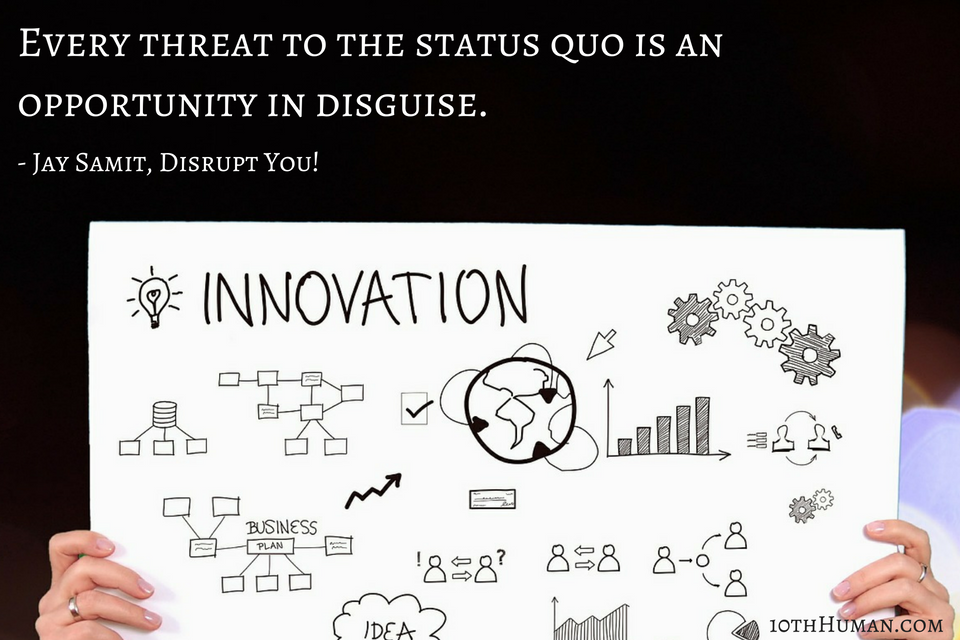
Every threat to the status quo is an opportunity in disguise.I’ve previously blogged about the need of businesses to evaluate their strategies as a function of thermodynamics:

The short answer is that a business that does not engage in the continual evaluation of their operations becomes isolated from their competition. Their entropy increases.

I’ve also discussed this as a function of the evolution of a business in a competitive marketplace.

What got you there will not keep you there. 

Today, I’d expand that line of thought by citing Anthony Giddens, a sociologist, and a particular thought on structures:

Structures do not determine outcomes, but define the potential range of outcomes. (Giddens)

In the context of the running discussion here about strategies and frameworks, I think it reasonable to posit that a framework and strategy do not determine an outcome but helps define the potential range of outcomes. Specifically, it helps you consider input, evaluate your options and execute your decision in accordance with defined parameters (such as goals and values).

10thHuman: Language as a framework for knowledge

credit: pixabay
credit: pixabay

I recently blogged about the importance of language in leadership, relaying that “leadership and language are essential partners in business (Van Etta, 2016).”

In the same post, I wrote that language reflects our thoughts, our essence. Leadership is the thoughtful and methodical application of a continually studied framework that becomes a mindset.

Building on the same thoughts on the importance of language and viewing language as a framework, I would share this thought:

The entirety of human knowledge is contained with the framework of ‘language’. Without an agreed upon framework, this knowledge would cease to be decipherable. It would cease to exist. – Me

Fundamentally, language is a construct we use to house and share knowledge and ideas. Language is important. It’s use is important in the spread of ideas, in the motivation of people and the implementation of ideas.

I’d share one more thought with you today.

Words are not just words. They are thoughts given life, an act, which inspire others to further action.