Leadership

The effect we have on others-2Happy Monday, folks! I’ll take just a moment to apologize for my silence of the last month. I’m still very much committed to the idea of daily posts as a career decision and my battle rhythm. Life often has a…penchant…for getting in the way of our operational models for the same. Tangentially related: this is a good reason for having an operational model or framework. These aren’t meant to be necessarily hard and fast but are plans. You CAN deviate from your plan. Your framework should be your baseline, to which you can return to time and time again.

Anyhow, today leadership is very much on my mind.

It’s a topic I’ve written about several times here. Definitions abound but my working definition of leadership is this:

Leadership is the thoughtful and methodical application of a continually studied framework that becomes a mindset.

Leadership is study.

Leadership is explorative.

Leadership is evolving.

Leadership is learning.

Leadership is language.

Leadership is is perspective.

Leadership is an awesome responsibility and ought not to be undertaken lightly. The best leaders I know are committed learners who have a ripple effect on those around them.

People want to follow good leaders.
10thHuman: On the other side of every interaction is a human being…

The effect we have on others-2I’ve blogged previously about the need for authentic, civil communication.

Tonight, I’d expand upon this, maybe step back a bit and ask us all to pause and consider that on the other side of every interaction is a human being.

From a professional perspective, this will absolutely help your business. Consider, please, the last place you visited where the representative of the business didn’t make eye contact, didn’t engage with you, didn’t acknowledge you…is this a place likely to earn your business again?

On the other side of the equation, when you last visited Starbucks or the Apple Store (both known for their customer service), how were you made to feel? Likely, you were made to feel like you belonged, like you were a member of their team or tribe.

From a personal perspective, I think this is a valuable lesson to remember as we interact with our fellow people. We are all part of this tribe called humanity and I believe, if we could just try to see the world through one another’s eyes, we could accomplish wonders.

10thHuman: Why you should continually evaluate your framework

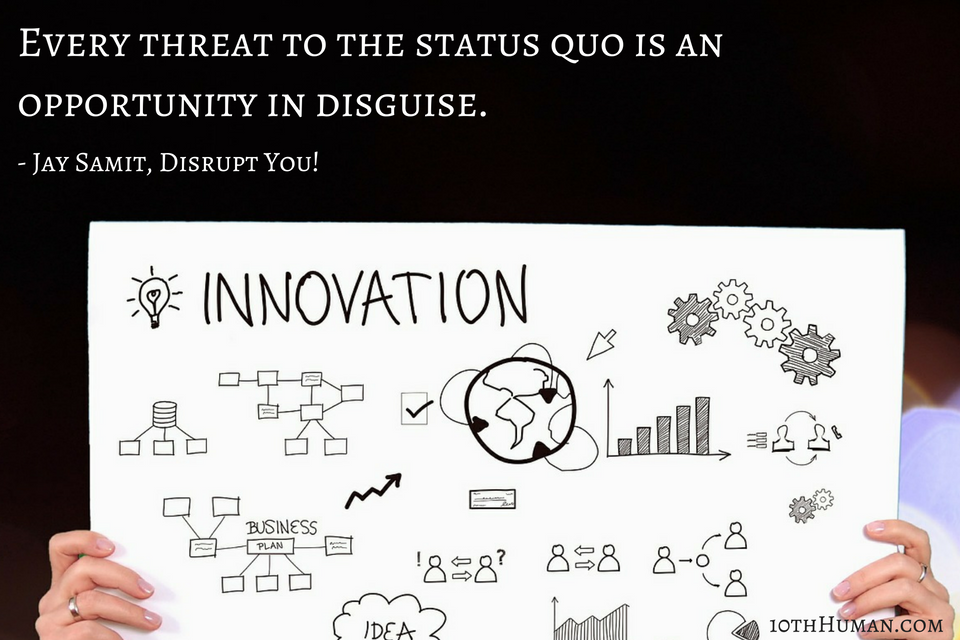
Every threat to the status quo is an opportunity in disguise.I’ve previously blogged about the need of businesses to evaluate their strategies as a function of thermodynamics:

The short answer is that a business that does not engage in the continual evaluation of their operations becomes isolated from their competition. Their entropy increases.

I’ve also discussed this as a function of the evolution of a business in a competitive marketplace.

What got you there will not keep you there. 

Today, I’d expand that line of thought by citing Anthony Giddens, a sociologist, and a particular thought on structures:

Structures do not determine outcomes, but define the potential range of outcomes. (Giddens)

In the context of the running discussion here about strategies and frameworks, I think it reasonable to posit that a framework and strategy do not determine an outcome but helps define the potential range of outcomes. Specifically, it helps you consider input, evaluate your options and execute your decision in accordance with defined parameters (such as goals and values).

10thHuman: Language as a framework for knowledge

credit: pixabay
credit: pixabay

I recently blogged about the importance of language in leadership, relaying that “leadership and language are essential partners in business (Van Etta, 2016).”

In the same post, I wrote that language reflects our thoughts, our essence. Leadership is the thoughtful and methodical application of a continually studied framework that becomes a mindset.

Building on the same thoughts on the importance of language and viewing language as a framework, I would share this thought:

The entirety of human knowledge is contained with the framework of ‘language’. Without an agreed upon framework, this knowledge would cease to be decipherable. It would cease to exist. – Me

Fundamentally, language is a construct we use to house and share knowledge and ideas. Language is important. It’s use is important in the spread of ideas, in the motivation of people and the implementation of ideas.

I’d share one more thought with you today.

Words are not just words. They are thoughts given life, an act, which inspire others to further action.

10thHuman: Perspective. Have you seen the world through my eyes?

credit: pixabay
credit: pixabay

Have you seen the world through my eyes?

The question was asked in response to my having offered assistance to a complete stranger. When I relayed what I’d done to a friend, they offered that they would have wanted to do the same but would have hesitated in doing so for a fear of physical safety.

This is a question I think about every day and could be – should probably be – the subject of a much larger post than this is likely to be.

Have you seen the world through my eyes? 

This question stopped me in my tracks when it was asked and still resonates with me today, in a profound way. It’s a question I have asked thousands of young leaders, when I taught a course on leadership, ethics and perspective at the United States Air Force Academy.

The short answer is, of course, “No.”

The longer answer is, “What a powerful question to ask. While I cannot do so, I can and surely ought to try.”

From a personal and business perspective, sincerely asking this question launched a journey of introspection of which this blog is the current manifestation.

From a business perspective alone, what an incredible cornerstone of a framework to consider our actions through.

Have we seen the world through the eyes of a consumer or a client?

Have we seen the world through the eyes of our partners or vendors

Have we seen the world through the eyes of our employees? 

Phrased and applied another way:

Have we tried to see ourselves as others see us?

I don’t offer definitive answers here, just food for thought.

Leadership and language are essential partners in business

The effect we have on others-2

In a recent conversation about The Value of I don’t Know, a friend and valued mentor of mine, Theresa Lewandowski Van Etta relayed this:

Leadership and language are essential partners in business.
– Theresa Lewandowski Van Etta

This resonated with me. Let’s chat about the ‘why’.

I’ve previously blogged about the power of language, which I think is also summed up by Leah Boroditsky when she says:

What we have learned is that people who speak different languages do indeed think differently and that even flukes of grammar can profoundly affect how we see the world.

Words are the physical manifestation of an intent to speak, the audible result of will.

If we can readily agree that language, that our words, matter then it is not a leap to see why our words impact leadership.

Language reflects our thoughts, our essence. Leadership is the thoughtful and methodical application of a continually studied framework that becomes a mindset.

If our language does not reflect the culture we are trying to build in our businesses, it impacts and affects our leadership ability and credibility.


10thHuman.com: On the value of ‘I don’t know’

image from pixabay
image from pixabay

One of my favorite quotes is ‘a wise man knows that he knows nothing.’

We could launch into an existential discussion of repeated observation being the basis of what we ‘think’ we know but for the purpose of this blog post, I’ll stick to a business aspect.

What possible positive business benefit could there be in admitting you don’t know something?

I can think of several:

  1. It’s authentic.
  2. It can (should) be part of your framework. The ability to learn faster than the competition is the only sustainable competitive advantage.
  3. It’s thermodynamic. Remember that the strategy that got you to the top will not keep you there. Your business requires a steady stream of new input and effort. Admitting you don’t know and questioning what you think you know will help keep you on top of your field.
  4. It “shifts your focus to process over outcome.” (Ritholtz, 2013)

I want to highlight #4, in particular.

What does this mean? This ‘process over outcome’?

I talk a lot about frameworks. Admitting you don’t know and incorporating the sustainable competitive advantage of continual learning into your framework will help position your business for sustained success.


10thHuman: Do I need a grandiose vision?

globe-1290379_640No.

No, you do not.

This is not to say you don’t need a long term plan, or that you don’t need to be thinking about the future of your business.

Here, I mean does your vision have to be grandiose…does it have to solve a global problem?

I suggest the answer to that question is, “No.”

In my profession as a Realtor®, my mission is to help people at their level of need at the moment in time I connect with them.

In my passion as a blogger here, my mission is to connect with YOU and share my thoughts on personal and business development.

I don’t think I can change the world; I’m just trying to change the small part of it around me.

How does language form our thoughts?

I woke up today thinking about language and it’s impact on our lives. It seems to me that language inherently both limits and expands our ability to frame thoughts. This is a premise of the book 1984 by George Orwell, in which the powers that be seek to manipulate existing language to remove the ability of people to even express negative thoufile-oct-09ghts. How powerful language is, when we stop to consider this premise.

When researching this line of thought, I was quite surprised to learn this is a relatively new line of thought. I encourage you to read the whole article, but this piece by Leah Boroditsky sums up eloquently what I struggle to articulate:

What we have learned is that people who speak different languages do indeed think differently and that even flukes of grammar can profoundly affect how we see the world.

I’ve previously blogged about why I think theory matters. Boroditsky expands beyond my post describing theory as a framework, describing a much broader vision of language as a framework for the very essence of thought.

Well worth the read!

It is not incumbent upon the world to conform to your vision of change. – Jay Samit

credit: pixabay
credit: pixabay

Do you have an idea that is failing to launch? Seth Godin, the NetworkingBlogFather, calls ideas that explode Purple Cows. If your purple cow is failing to launch, there is a tendency to want to explain this away as ‘well they just don’t understand the idea or the potential’.

I have engaged in this line of thought, too, thinking that an idea I had was just waiting to go viral. If just the right person picked it up, or just the right person saw the potential, then surely it would explode across the Internets.

Then I read Disrupt You! by Jay Samit and came across this line:

It is not incumbent upon the world to conform to your vision of change. – Jay Samit

This rocked my metaphorical world. I’d been expecting the potential of my idea to speak to people, to speak for itself.

But, that’s not how this works. If a consumer has to realize the potential of the idea and look passed delivery of the same, the idea will probably not launch.

If your idea isn’t launching, take an objective look (or have someone else do so).

Does the idea answer a specific, easily articulated need?

If not, it is incumbent on YOU as the idea owner to figure out a new approach.